

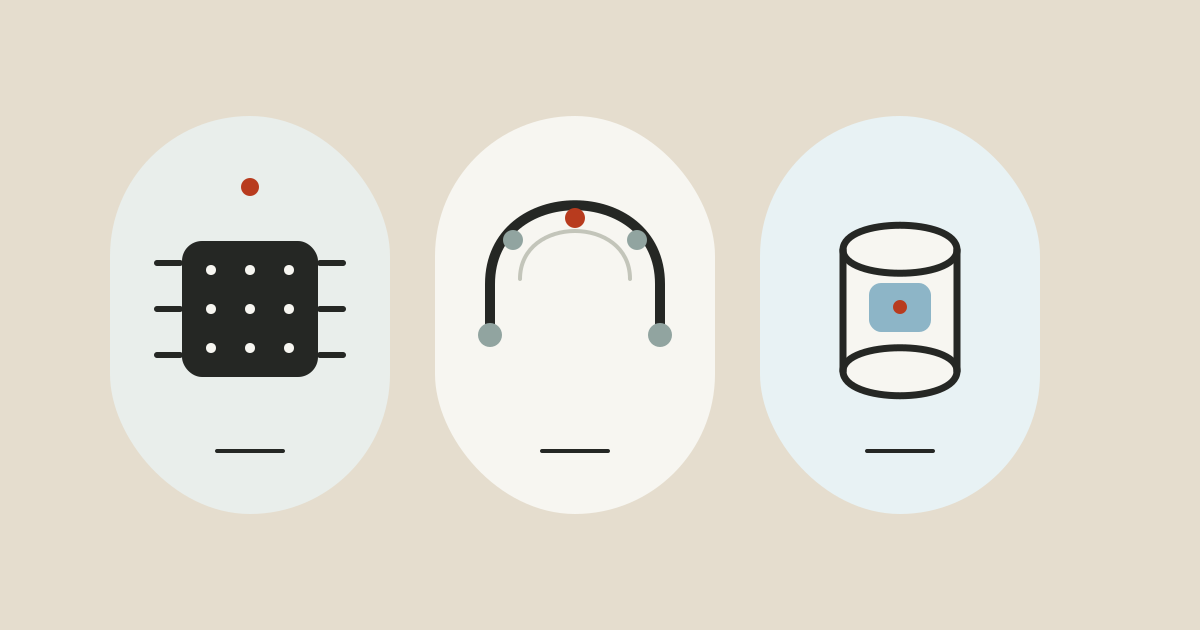
A brain implant, a headset and a wristband walk into a headline. Somehow, any of them can leave as “mind reading”. Before choosing a side in the argument about the future, it helps to find out which device actually turned up.
Evidence guide, written November 6, 2026. The studies and funding announcement below are dated examples, not claims that they are today's newest products.
First, find the sensor
An implant records from inside the skull. In a June 2025 speech study, four arrays containing 256 microelectrodes recorded brain activity from one man with ALS. Software turned attempted speech into synthetic voice. Some output was intelligible; some was not. This required surgery and personalised research equipment. [1]
For a closer look at speech, follow the studies separating faster output, clearer words and more expressive communication. They tested different systems and participants.
An EEG headset records electrical activity at the scalp. It avoids an implant, but the signals are harder to separate spatially and have a lower signal-to-noise ratio. In a 2025 experiment, people imagined finger movements to control corresponding fingers of a robotic hand. That is a defined control task, not a transcript of their internal lives. [2]
An EMG wristband records electrical activity from muscles. Meta's 2025 research used surface electromyography for navigation, gestures and handwriting input. Muscle signals can reveal intended movement without conspicuous gestures, but measuring them at the wrist is different from recording the brain. The study reported median handwriting performance of 20.9 words per minute in a closed-loop task. [3]
The location is not a trivial technicality. It tells you what signal the system has access to and what kinds of claims need evidence. You would not review a microphone, a camera and a keyboard as if they were three brands of the same sensor.
Then, count the people who made it into the result
The robotic-finger EEG study reported 80.56% accuracy for two-finger imagery and 60.61% for three-finger imagery in 21 able-bodied, experienced BCI users. Participants were screened: 18 were excluded for insufficient performance, and 10 withdrew because of scheduling. Its authors explicitly say the findings should not be read as applying to the general population. [2]
That is useful research, with a narrower answer than “anyone can control a robot with a headset”. Ask whether a percentage describes selected users, every enrolled participant, an offline replay or live control. Also ask what counted as correct. Choosing between two commands and composing an unrestricted sentence are very different exams.
A permission slip is not a graduation certificate
The FDA distinguishes permission to investigate from permission to market. An Investigational Device Exemption can allow an unapproved device, or an existing device's new use, to be studied for safety and effectiveness. It does not establish that the device has already passed that evaluation. [4]
Breakthrough Device designation is another separate milestone: it provides a route for more intensive interaction and prioritised review. The device must still meet the relevant standards to receive marketing authorisation. When a pitch says “FDA”, look for the noun that follows it and the precise use covered. [5]
Follow the money, then return to the methods
On June 2, 2025, Neuralink announced a $650 million Series E. Named participants included ARK Invest, Founders Fund, G42, QIA and Sequoia Capital. This is a company-reported financing milestone. It is not a clinical endpoint, and those investor names do not independently establish patient benefit. [6]
The Meta wristband paper discloses that all contributors were current or former Meta employees. The ALS voice paper discloses patents, licensing and other industry relationships involving several authors. Those connections are part of the evidence record. Read the disclosed roles alongside the methods and results; a financial connection alone does not determine whether a finding holds up. [3] [1]
A helpful funding map distinguishes investor, device manufacturer, research institution and study sponsor. A shared investor does not make two devices equivalent, and a commercial relationship does not tell you whether an endpoint was measured well. Follow the documented connection as far as it goes; do not draw the remaining arrows from suspicion.
Two examples make that distinction tangible: Precision’s temporary electrode clearance concerns a particular component and use; MintNeuro’s financing concerns chips for device developers. Neither story establishes the performance of every system built around an electrode or chip.
What would convince you?
For a future device you might use, ask for results in people with needs like yours, useful performance outside a demonstration, failures as well as successes, and a practical account of setup and support. Ask what happens to the recording, whether you can stop collection, and what continues working if the provider changes direction.
There is room to be excited by this field while staying specific. A person gaining a useful way to communicate or control a device is a substantial achievement. It deserves a clearer description than a headline that turns every electrical signal into telepathy.