Key Findings
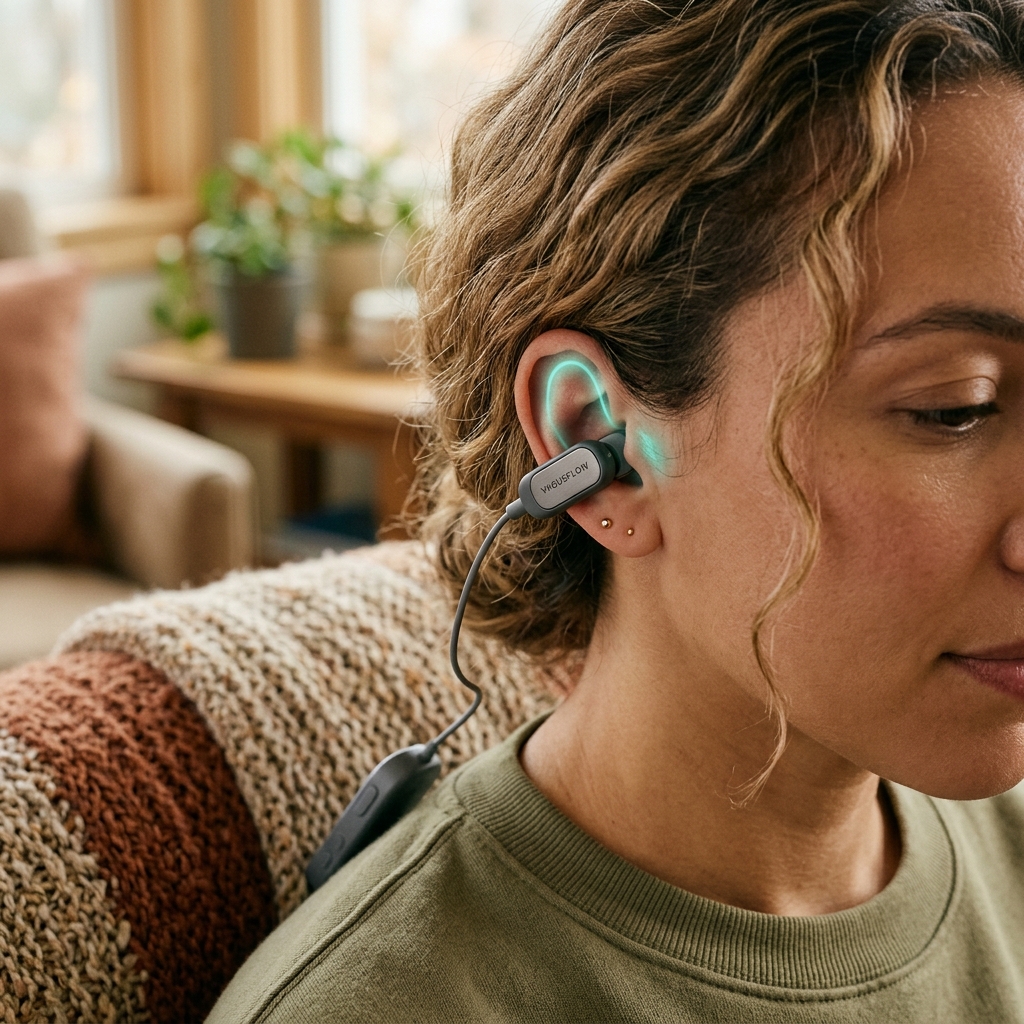
Slow waves are oscillations that reflect rhythmic alternation of neuronal activity and mediate key restorative functions of non-rapid eye movement (NREM) sleep. Left ventromedial prefrontal cortex regions are a "hot spot" for slow wave generation. The enhancement of slow wave activity (SWA, 0.5-4 Hz) has been shown to be beneficial, as in improving memory performance. To overcome limitations of current techniques, we assessed the ability of a non-invasive neuromodulatory tool, Transcranial Electrical Stimulation with Temporal Interference (TES-TI), to enhance SWA during NREM sleep overnight in healthy humans. The current study is an interim analysis focused on the effects of TES-TI during NREM sleep in a laboratory setting. Two high frequency carriers with 1 Hz difference (TES15kHz-TI1Hz) produced amplitude-modulated temporal interference at 1Hz. Data were collected at the University of Wisconsin-Madison as part of the STRENGTHEN study (ClinicalTrials.gov, NCT06267521, 02/12/2024, single-blind, non-random allocation). Eligible participants were healthy adults (ages 18-50) assigned in parallel to one of four groups: (Group 1) TES15kHz (0 Hz difference frequency) 2 nights per week and meditation; (Group 2) TES15kHz-TI1Hz (1 Hz difference frequency) 2 nights per week and sham meditation; (Group 3) TES15kHz-TI1Hz 1 night per week and meditation; (Group 4) TES15kHz-TI1Hz 2 nights per week and meditation. Stimulation targeting left ventromedial prefrontal cortex occurred during NREM sleep over repeated nights ( ~ 10 stimulation periods, 3-min each, first half of night, 1-2 nights/week, 4-week protocol). Twenty-one participants (Groups 2, 3, 4) received TES15kHz-TI1Hz and seven participants received TES15kHz (Group 1). SWA was measured using simultaneous high-density electroencephalography with polysomnography. We show that SWA is increased with TES15kHz-TI1Hz (N = 21 total; N = 5 Group 2, N = 10 Group 3, N = 6 Group 4), and the effect outlasts the stimulation period; higher frequencies (sigma and beta) decrease. During stimulation, SWA is greater in TES15kHz-TI1Hz than pure TES15kHz (N = 7 Group 1). The incremental effects of TES15kHz-TI1Hz on SWA between first and last intervention night are positively associated with subjective ratings of restorative sleep. To our knowledge, this is the first study demonstrating that TES-TI enhances SWA and potentially its restorative function. Slow waves are signature patterns of electrical activity indicative of deep sleep. They play an important role in the ability of sleep to be and feel restorative. Boosting slow wave activity has been shown to be beneficial for memory and cognition but the current techniques for doing so have limitations. Here, we use a non-invasive technique—Transcranial Electrical Stimulation with Temporal Interference (TES-TI)—that overcomes these limitations and allows for sensation-free modulation of deep brain regions that can be performed with simultaneous electroencephalography (EEG) to record brain activity during sleep. The main findings support the ability of TES-TI to enhance slow wave activity during non-rapid eye movement sleep in healthy humans. Future studies that build upon this work by investigating the TES-TI mechanism of action and optimizing parameters will serve as important steps toward the utilization of TES-TI for the improvement of sleep.
Why This Matters for Body-Mind Practice
[Draft — editorial context needed]