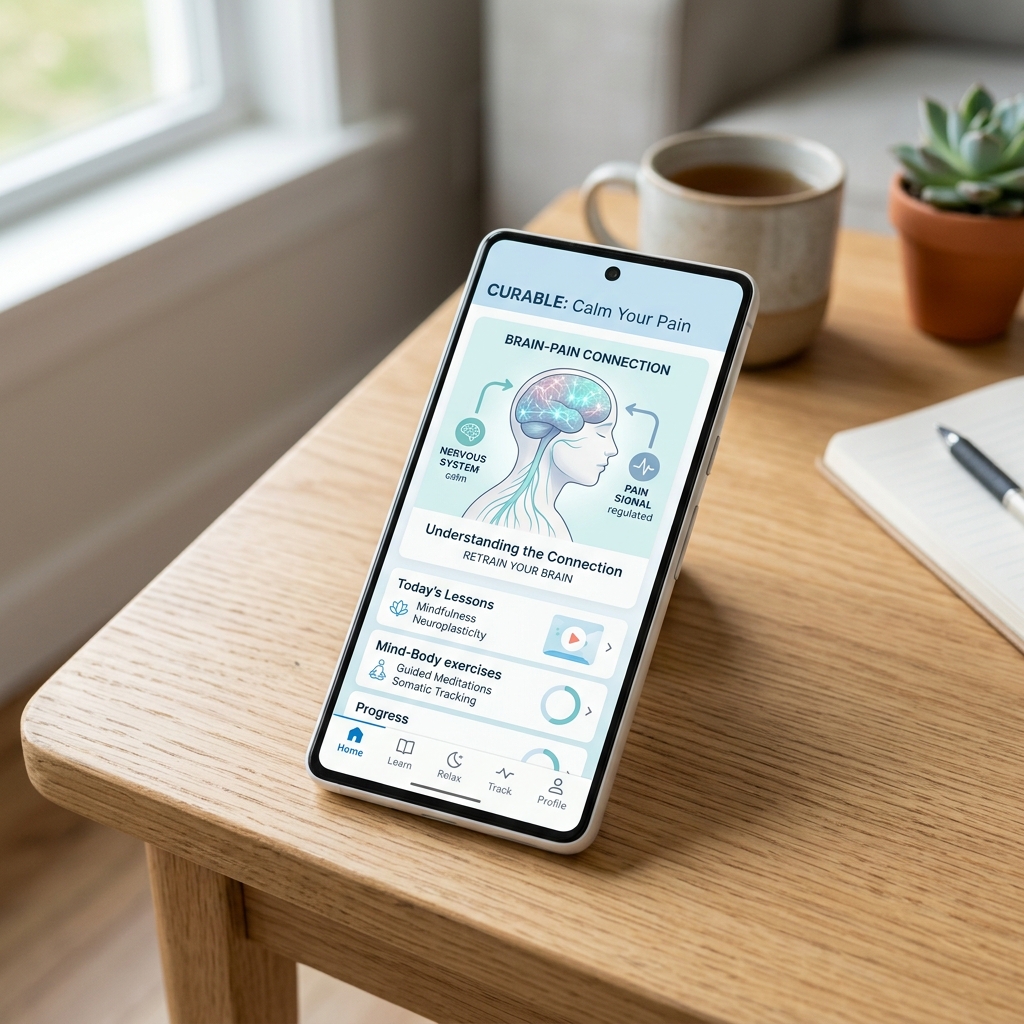
What Curable Does
Curable is a mobile app ($12.99/month) that delivers a structured pain neuroscience education (PNE) program through guided audio sessions, journaling prompts, and somatic tracking exercises. No hardware. No supplements. No devices.
The core premise: chronic pain is often driven by central sensitization — the nervous system amplifying pain signals beyond what tissue damage warrants. By educating users about pain mechanisms and teaching them to modulate their nervous system's threat response, Curable aims to reduce pain without targeting the body at all.
It's based on the same science behind Pain Reprocessing Therapy (PRT), which received landmark validation in a 2022 JAMA Psychiatry trial showing that 66% of chronic back pain patients were pain-free or nearly pain-free after PRT — compared to 20% in the placebo group.
The Evidence
Curable has more clinical support than most health apps:
A 2022 peer-reviewed study published in the Journal of Medical Internet Research (n=263) found that Curable users showed statistically significant reductions in pain intensity, pain catastrophizing, and kinesiophobia (fear of movement) over 30 days.
A 2024 follow-up study tracked users for 6 months and found sustained improvements in pain, function, and psychological wellbeing. Users who completed the full program showed larger effects than those who used it intermittently.
The underlying science is robust. Pain neuroscience education is supported by multiple systematic reviews and meta-analyses. A 2019 Cochrane-adjacent review found moderate-quality evidence that PNE reduces pain and disability in chronic musculoskeletal conditions.
What It Gets Right
- Psychoeducation is the foundation. Understanding that chronic pain can be driven by neural sensitization rather than tissue damage is itself therapeutic. This isn't "it's all in your head" — it's "your nervous system is sending inaccurate alarm signals."
- Somatic tracking — the practice of observing pain sensations with curiosity rather than fear — directly addresses the threat-appraisal mechanism that maintains central sensitization.
- No false promises. Curable doesn't claim to cure all pain. They explicitly state that structural and inflammatory conditions require medical treatment and that their approach targets neuroplastic pain specifically.
- Affordable and accessible. At $12.99/month with no hardware requirement, it's one of the most accessible nervous system interventions available.
Limitations
- Not for all pain types. Acute injuries, inflammatory conditions, and pain with clear structural causes need medical treatment. Curable is for chronic pain where central sensitization is the primary driver — but many users may not know which category they fall into without medical evaluation.
- Requires consistent engagement. The 30-day study showed effects in compliant users, but real-world adherence to app-based programs is typically 20-30%. The app works — if you use it.
- Self-selection bias in studies. People who download a pain neuroscience app are already open to the idea that pain has a neural component. Whether the approach works for people who believe their pain is purely structural is less clear.
The Bottom Line
Curable is one of the rare health apps where the claims are actually supported by the underlying science. Pain neuroscience education works. Pain reprocessing works. And delivering these interventions through an affordable, accessible app is a genuine contribution to the chronic pain space.
NORM scored Curable 71/100 — GENERALLY ALIGNED. The science-claim match is strong, the price is fair, and the limitations are honestly communicated.
The most effective pain treatment might not be a pill, a procedure, or a device. It might be understanding how pain works.


