
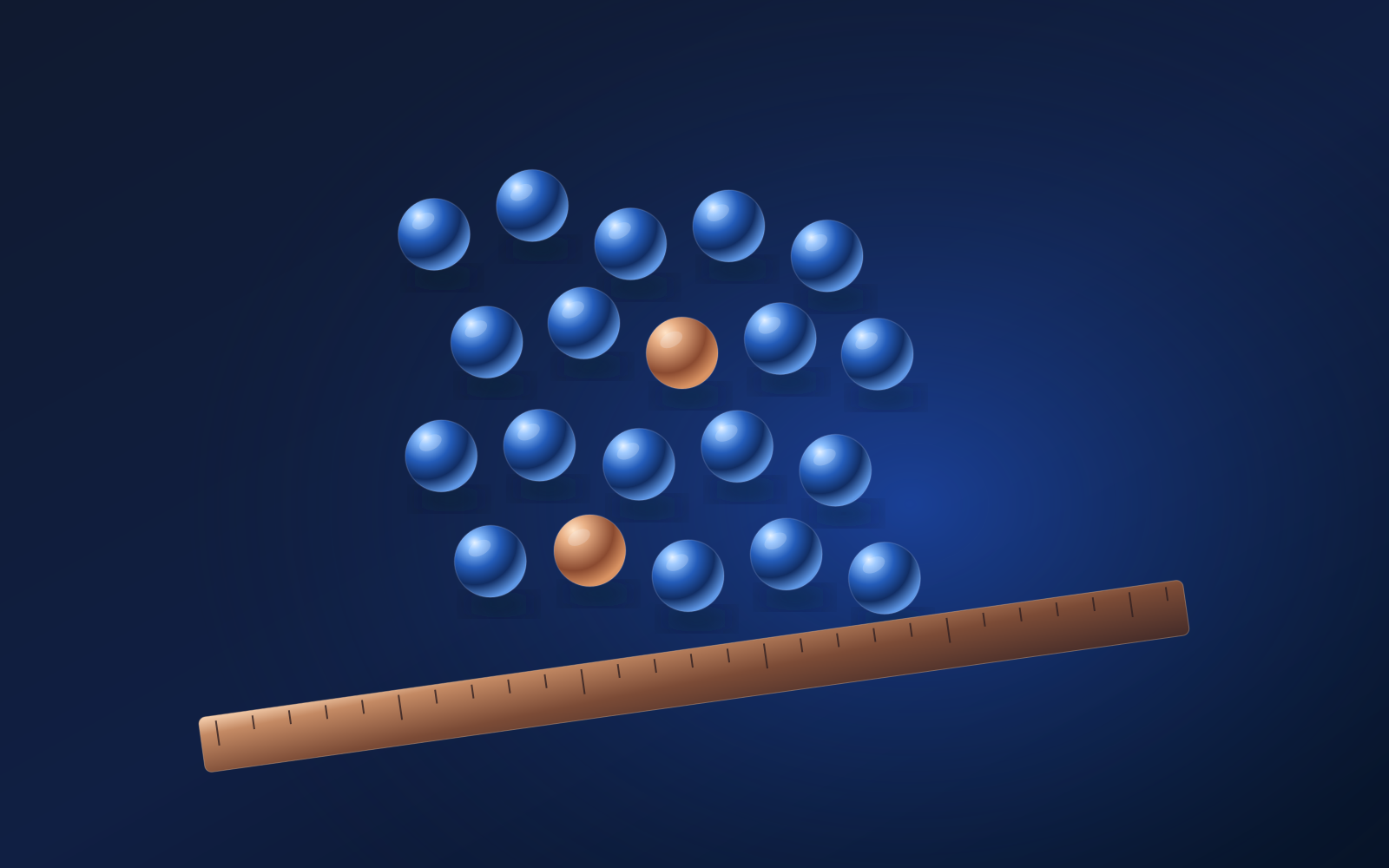
Original Body Mind State conceptual illustration of number-range adaptation. Not a study figure.
Try it with Pip · A question in perception
How many dots did you see?
Two quick looks. Give your first impression each time.
Look 1 of 2
Expect 10–25 dots
Read the explanation instead
Both displays contain 20 dots. In the study, estimates were less precise across a wider range of possible quantities. This is a demonstration, separate from the study’s measurements.
How many dots did you just see? It is a simple question with an unexpectedly flexible answer. A new human study suggests that the range of possibilities helps shape how precisely we estimate a quantity.
A small change to the question
Researchers asked 39 healthy adults aged 18–34 to estimate dot clouds shown for 600 milliseconds. In one condition, the possible quantities ranged from 10 to 25; in another, from 10 to 40. Estimates were more variable in the wider range. [1]
Models fitted to fMRI activity in number-sensitive parietal cortex shifted and broadened with that range. Participants’ changes in modelled neural precision were also associated with changes in their estimation precision. The researchers interpret this as an adjustment that spreads representation across a broader range, at a cost to absolute precision. [1]
The ruler is a metaphor
We usually picture a measuring instrument as something stable: the ruler stays put while the objects change. This experiment makes a different possibility interesting. The scale used to represent a quantity may itself depend on the context.
That distinction changes the question we ask of performance. Rather than stopping at “How precise was the answer?”, we can also ask “What range of answers did the task require?” A broader demand and a noisier estimate can belong to the same explanation. The comparison becomes part of the story.
What the experiment can tell us
These were fMRI signals and fitted models, not individual-neuron recordings. Dot density and total visual area were not fully controlled; the response slider may introduce spatial-attention or motor influences. Everyday transfer remains an open question. Published November 5, 2026, this is a peer-reviewed accepted manuscript awaiting final editing. [1]
Follow the question
Would the pattern appear with sounds instead of dots? With objects we recognize? With a spoken answer instead of a slider? How quickly would precision change when a familiar range returned?
Those questions help locate the next experiment. They also make perception feel more interesting: something we can investigate by changing the conditions, observing the response, and asking which part of the explanation still holds.
Another new study held the image steady while people learned to recognize it. See what changed when the picture stayed the same.