What Is It?
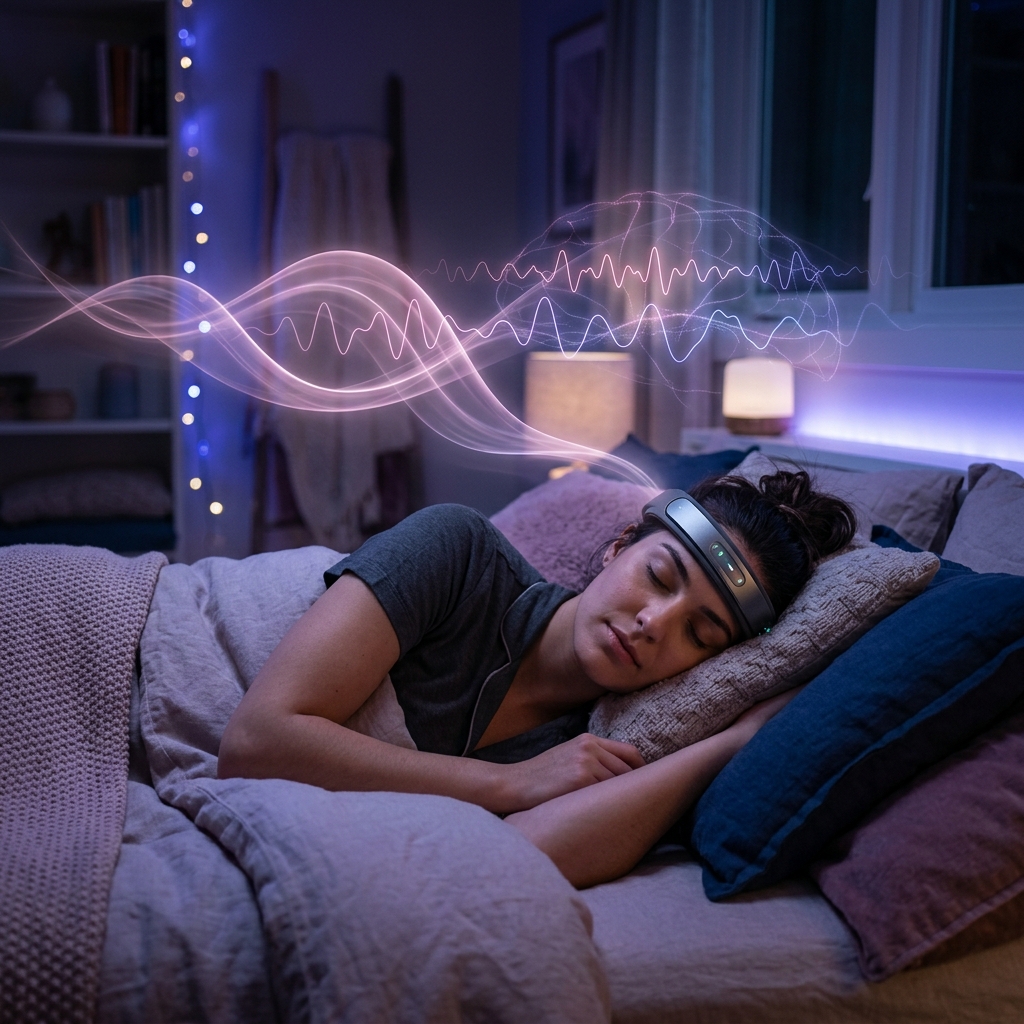
The Muse S Athena's "Deep Sleep Boost," released April 2026, is a feature that monitors your brain waves in real-time while you sleep, detects when you enter slow-wave sleep (SWS), and plays precisely timed bursts of "pink noise" — a softer, lower-frequency variant of white noise — to amplify and stabilize your deep sleep cycles.
It also introduced "Smart Wakeup," which uses EEG data to wake you during your lightest sleep phase rather than by alarm clock time.
The Science It's Based On
Auditory stimulation during slow-wave sleep is one of the more compelling areas of sleep neuroscience. Multiple peer-reviewed studies — including work from Northwestern University and ETH Zurich — have demonstrated that phase-locked acoustic stimulation (sound pulses timed to the "up-state" of slow oscillations) can enhance slow-wave activity and improve subsequent memory consolidation.
The key word is "phase-locked." The sound must be delivered at exactly the right moment in the slow-wave cycle — during the depolarization phase — to amplify the oscillation rather than disrupt it. This requires real-time EEG monitoring with millisecond precision.
This is where consumer devices face their biggest challenge: clinical studies use medical-grade polysomnography in controlled lab settings. A headband worn at home in a normal bed, subject to movement artifacts and variable electrode contact, needs to achieve the same temporal precision.
What Makes Muse Different
Unlike most sleep gadgets that just track sleep stages retroactively, Muse's approach is interventional — it claims to actively change your sleep architecture in real time. That's a fundamentally different proposition than passive monitoring.
The Muse S Athena uses dry EEG sensors (no gel, no prep), fNIRS (functional near-infrared spectroscopy) for blood oxygenation, and accelerometers for movement. The combination gives it more data channels than any other consumer sleep wearable.
What We Don't Know
Muse has published peer-reviewed validation studies for their meditation EEG accuracy. They have not yet published a peer-reviewed study specifically validating the Deep Sleep Boost's phase-locking precision or its effect on slow-wave duration in a home setting.
The difference between "the science of auditory sleep stimulation is real" and "this device delivers auditory sleep stimulation effectively" is where most consumer neurotechnology falls short.
The Bottom Line
Muse is one of the few consumer brain devices built by neuroscientists with actual publications. The science behind auditory slow-wave enhancement is robust. The question — as always — is whether the consumer implementation delivers what the lab studies achieved.
Muse scored in the yellow range for evidence transparency. They're closer to the science than most. Whether they've crossed the line from "based on research" to "validated by research" for this specific feature is what a deeper evidence review reveals.


