

“I see what you mean.” A useful phrase. An ambitious assumption.
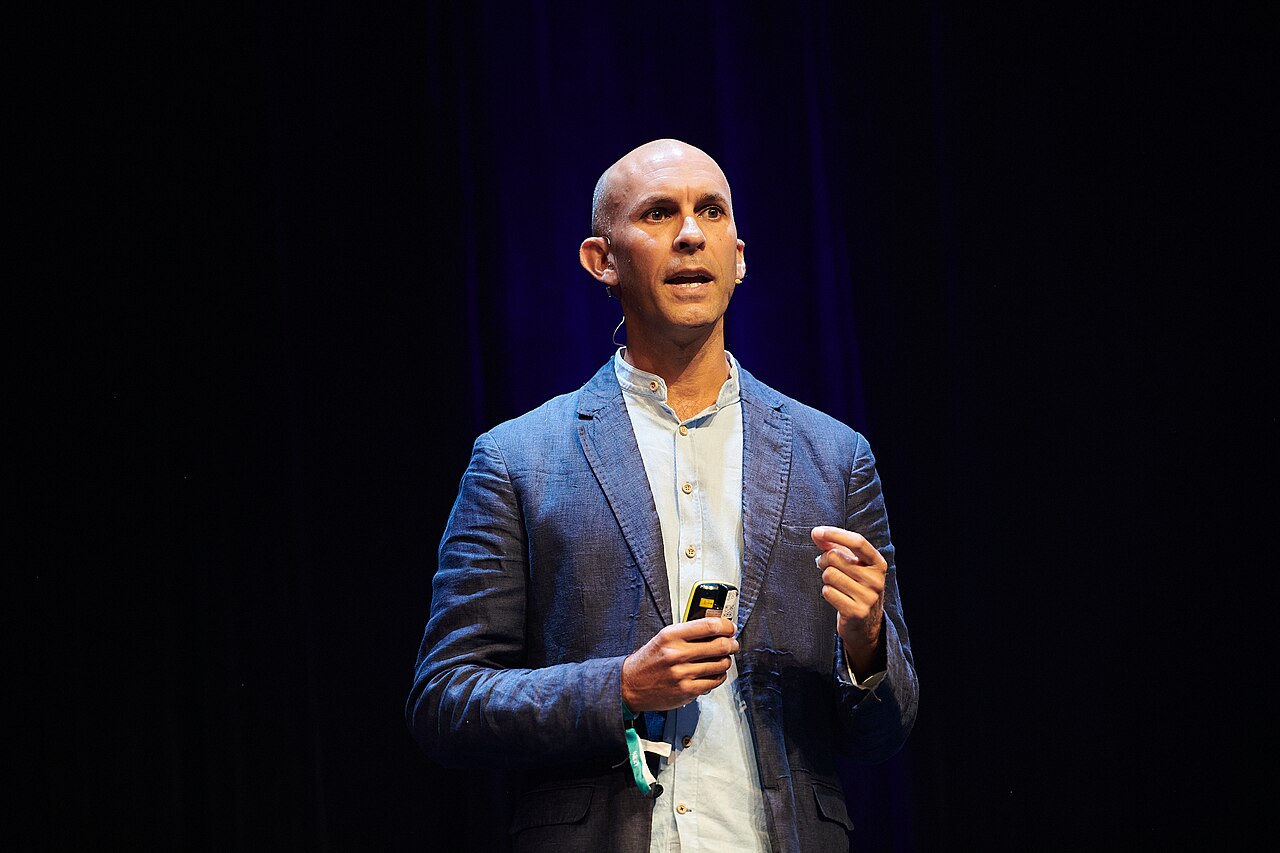
Anil Seth investigates the gap between the world around us and our experience of it. Our first The Mind Behind It profile follows that question through psychology, robotics and consciousness research—and into the minds we imagine inside machines.
The question he kept coming back to
Seth is Professor of Cognitive and Computational Neuroscience at the University of Sussex, director of its Centre for Consciousness Science and co-director of CIFAR’s Brain, Mind and Consciousness programme. His 2021 book Being You brought his account of consciousness to readers outside the lab. [1]
The route there was less tidy than a biography makes it look. In his own Sussex retrospective, he describes moving from experimental psychology at Cambridge into cognitive science and AI at Sussex. Evolutionary robotics became his doctoral focus. By the time he finished in 2000, he felt he had travelled away from the question that most interested him: how the brain gives rise to conscious experience.
In 2001, he moved to San Diego to work with Gerald Edelman at the Neurosciences Institute. Five years later, he returned to Sussex. The recurring theme in his account is a wish to explain experience, rather than only identify brain activity that accompanies it. [2]
Your brain does some editorial work
One idea Seth explores is predictive perception: experience shaped by the brain’s expectations alongside information arriving through the senses. He often discusses this through the phrase “controlled hallucination.”
The second word gets the attention. The first does important work.
In a 2020 Mind & Life conversation, Seth explained that sensory information constrains and updates perceptual predictions. “Controlled” does not mean that you consciously choose what to perceive. The idea is not a permission slip to manifest a more convenient world. He also acknowledged the challenge of finding evidence that distinguishes this account from alternatives. [3]
A vivid explanation is a way into the research. Consciousness remains an open question.
Taking the question out of the lab
The Perception Census turns curiosity about differences in experience into a large online research programme. It was developed through Sussex, the University of Glasgow and Collective Act, with Seth and philosopher Fiona Macpherson as principal investigators. Its questionnaires, illusions and interactive tasks investigate perceptual skills and differences. [4]
The project reports 33,780 participants from 133 countries. Its current data-collection phase has finished; the homepage says results will be developed and released over a three-year period. [5]
Participation totals describe the research effort, not the population as a whole. The interesting next step is the findings: what differs, how reliably it can be measured, and which explanations survive scrutiny.
A hand, a clock, an awkward question
A paper published in July 2026 offers a smaller window into this kind of work. Shu Imaizumi, Giuseppe Lai, Seth and Keisuke Suzuki used four virtual-reality experiments to examine perceived duration and agency—the feeling that you are causing an action. Participants moved their hands while virtual hands provided different visual feedback.
The authors reported that feedback timing was associated with changes in duration judgments and agency. This concerns subjective measurements in controlled tasks, not the passage of physical time. The data were collected in 2019; the paper also records departures from its preregistered analysis plans. Seth’s listed contributions include supervision, funding and review, alongside the team’s other roles. [6]
A large question, several people and a carefully limited experiment.
And then there is AI
Could a machine be conscious?
His Behavioral and Brain Sciences target article was first published online on 21 April 2025 and appears in a 2026 volume. He argues that consciousness may depend on our nature as living organisms, and considers artificial consciousness unlikely along current AI trajectories. More brain-like or life-like systems, he suggests, could change the prospects. [7]
A September 2026 preprint, which Seth co-authored, approaches the question through a framework for comparing theories. It makes the assumptions behind assessments explicit and shows how much conclusions depend on them. This is provisional theoretical work, not a test that establishes whether an AI is conscious. [8]
The distinction worth keeping is between producing intelligent behaviour and having an inner experience. A system talking fluently about feelings does not, by itself, settle whether it has them.
What we are watching
The next Perception Census findings. More precise tests of perceptual predictions. The evidence that might strengthen—or challenge—Seth’s position on artificial consciousness.
His public writing tells us how a research career found its question. What he wants to do next is a conversation we hope to have.
For now, the invitation is simple: follow the work, inspect the evidence, and be a little less certain that “I see what you mean” means the same thing to everyone.
Editorial note: This is a profile based on public sources, not an interview or endorsement. Sources were checked on 8 November 2026. The July study declares no competing interests; its funding includes public research grants and support to co-author Keisuke Suzuki from the Dr. Mortimer and Theresa Sackler Foundation. [6]
Follow Anil’s work
Follow the thread
- When recognition changes what people can see
A separate human study follows a related question about recognizing an unchanged image. Read its specific methods and limits.
- Can you feel your heartbeat—or estimate it?
This guide distinguishes sensing a body signal from estimating it, and explains why the measurement matters.
- How context changes a judgment
Follow another perception question into a specific number-estimation task and its limits.
Related reading updated .