The Second Brain Isn't a Metaphor
Your gut contains roughly 500 million neurons — more than your entire spinal cord. These neurons form the enteric nervous system (ENS), a mesh of neural circuits embedded in the walls of the gastrointestinal tract that can operate completely independently from the brain.
This isn't a supporting system. It's a parallel nervous system.
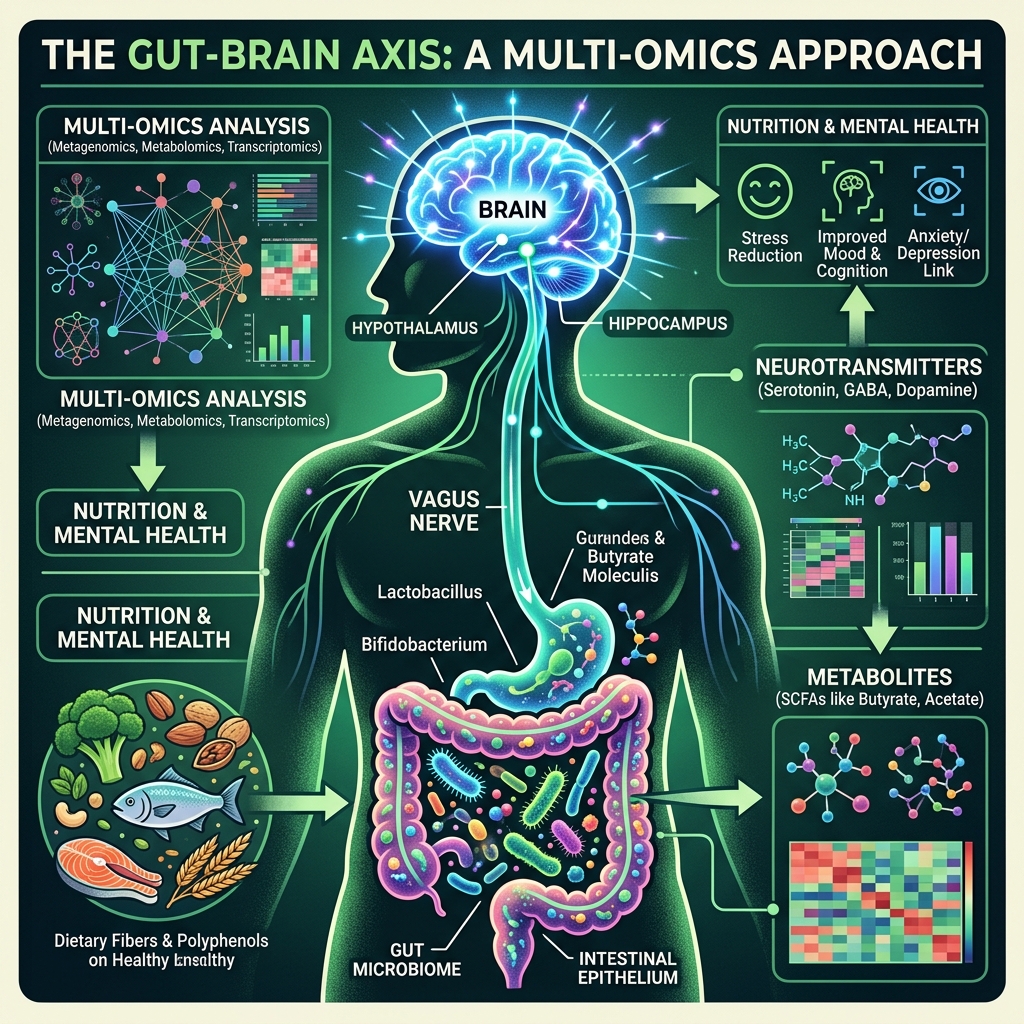
The ENS generates its own neurotransmitters, processes sensory information, coordinates complex motor patterns, and sends continuous status reports to the brain via the vagus nerve. Approximately 90% of serotonin and 50% of dopamine in the body is produced in the gut — not the brain.
The Vagus Nerve Highway
The vagus nerve is the primary communication channel between the gut and brain. And the traffic is heavily one-directional: 80-90% of vagal fibers are afferent — they carry information from the gut to the brain, not the other way around.
This means the gut is predominantly an informer, not a receiver. It shapes mood, anxiety levels, and stress responses by flooding the brainstem with status updates about the internal environment.
A 2023 study in Nature Neuroscience used optogenetic tools to selectively activate gut-to-brain vagal pathways in mice and demonstrated that gut signaling alone could induce anxiety-like or reward-seeking behaviors — without any change in external conditions.
Gut Inflammation and Mental Health
The link between gut inflammation and psychiatric symptoms is no longer theoretical:
- Irritable Bowel Syndrome (IBS) patients have a 60% comorbidity rate with anxiety and depression
- Inflammatory Bowel Disease (IBD) patients show altered amygdala reactivity on fMRI, even when GI symptoms are in remission
- Antibiotic-induced gut dysbiosis in healthy subjects produces measurable increases in anxiety scores within 7 days
- Probiotic supplementation (Lactobacillus rhamnosus) reduced cortisol reactivity and anxiety scores in a 2024 randomized controlled trial published in Translational Psychiatry
The mechanism appears to be inflammatory signaling. When gut barrier integrity is compromised ("leaky gut"), bacterial endotoxins enter the bloodstream and trigger systemic inflammation. This inflammation crosses the blood-brain barrier and activates microglia — the brain's immune cells — producing neuroinflammation that manifests as depression, anxiety, and cognitive fog.
Trauma Lives in the Gut
Perhaps the most striking finding: trauma alters gut function independently of conscious memory.
People with PTSD show significantly altered gut microbiome composition compared to trauma-exposed controls who didn't develop PTSD. Specifically, PTSD is associated with reduced Actinobacteria and Verrucomicrobia — bacterial phyla involved in maintaining gut barrier integrity and anti-inflammatory signaling.
This suggests a bidirectional loop: trauma alters the gut → the altered gut sends inflammatory signals to the brain → neuroinflammation maintains trauma symptoms → stress hormones further damage the gut lining.
Breaking this loop may require addressing both ends simultaneously. Somatic therapies that engage the vagus nerve (breathwork, cold exposure, craniosacral therapy) may work partly by modulating gut-brain signaling rather than purely through "top-down" cognitive processing.
Interoception: The Gut Feeling That's Actually Real
"Gut feelings" are interoceptive signals — the brain's representation of internal body states. The gut generates an enormous volume of interoceptive data that shapes emotional processing below conscious awareness.
Research from the University of Sussex (2024) demonstrated that people with higher interoceptive accuracy — the ability to accurately perceive internal body signals — showed better emotional regulation and lower anxiety scores. Critically, gut-derived interoceptive signals were the strongest predictors, more so than cardiac or respiratory signals.
This has direct implications for therapeutic approaches. Practices that enhance interoceptive awareness — mindfulness, body scanning, somatic experiencing — may work partly by improving the brain's ability to accurately read and respond to gut signals rather than misinterpreting them as threats.
What This Means
The gut-brain axis reframes mental health as a whole-body phenomenon, not purely a brain chemistry problem. Interventions that only target neurotransmitters in the brain (SSRIs, for example) may be addressing downstream effects while leaving the upstream gut-mediated signaling untouched.
Emerging approaches include:
- Vagus nerve stimulation — direct modulation of the gut-brain communication channel
- Targeted probiotics (psychobiotics) — specific bacterial strains selected for their neurotransmitter-modulating properties
- Anti-inflammatory dietary protocols — reducing gut inflammation to decrease neuroinflammatory signaling
- Somatic and breathwork therapies — vagal toning that modulates both gut function and emotional regulation simultaneously
The gut isn't just digesting food. It's co-authoring your emotional life.
500 million neurons, running their own program, talking to your brain 24 hours a day. Maybe it's time to listen.
Watch: How Your Gut Microbiome Affects Your Mental Health
An evidence-based exploration of the gut-brain axis — how bacterial metabolites, vagal signaling, and immune activation in the gut directly influence serotonin production, anxiety, and depression.