The Nervous System You Didn't Know You Had
In 1907, a British physiologist named Byron Robinson published a book with a peculiar title: The Abdominal and Pelvic Brain. His colleagues largely ignored it. The idea that the gut had anything resembling a brain seemed absurd — a relic of the kind of pre-scientific thinking that also attributed emotions to the liver and courage to the spleen.
It took nearly a century for science to catch up with Robinson's intuition.
In the late 1990s, neuroscientist Michael Gershon published The Second Brain, a book that reintroduced the medical world to the enteric nervous system — a vast, semi-independent network of neurons embedded in the walls of your gastrointestinal tract. The numbers were startling:
- 500 million neurons — more than in your spinal cord
- More than 30 neurotransmitters — including serotonin, dopamine, and GABA
- 90-95% of your body's serotonin is produced in the gut, not the brain
- The enteric nervous system can operate entirely on its own, without input from the brain
Your gut doesn't just digest food. It thinks — or at least, it processes information with a complexity that no other organ outside the skull can match.
The Vagus Superhighway
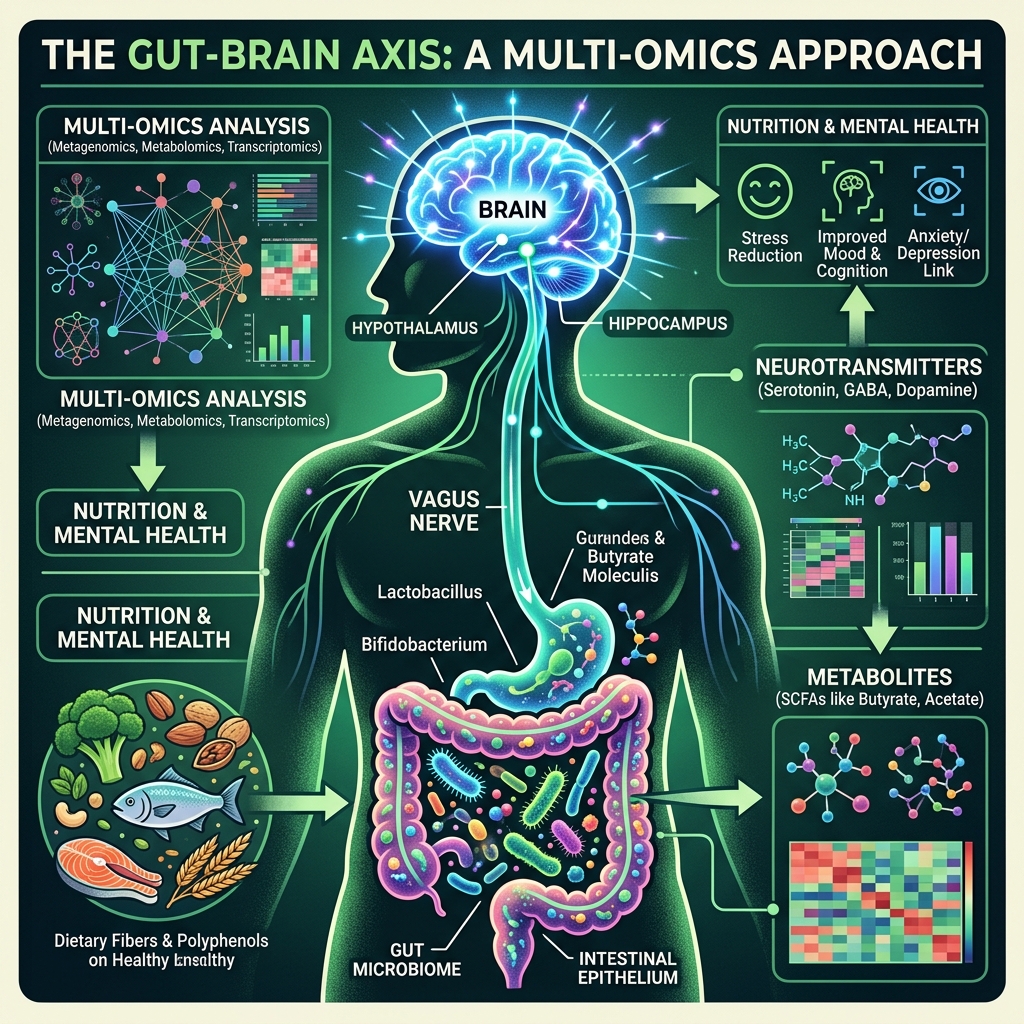
The gut and the brain are connected primarily through the vagus nerve — the longest cranial nerve in your body, running from the brainstem to the abdomen. But here's the detail that changes the picture: approximately 80% of the vagus nerve's fibers are afferent, meaning they carry signals upward — from gut to brain.
Your gut is talking to your brain far more than your brain is talking to your gut.
This upward information stream carries data about everything: what you've eaten, the chemical environment of your intestines, the state of your immune system, the metabolic outputs of your gut bacteria. Your brain receives this information and uses it to calibrate your mood, your energy, your motivation, your anxiety levels — all largely below conscious awareness.
When people say "I had a gut feeling," they're describing a real neurological phenomenon. The enteric nervous system detects patterns in your internal environment and transmits them upward through the vagus nerve. Your brain registers the signal as an intuition — a sense that something is right or wrong — before your conscious mind has processed the information logically.
Gut feelings aren't mystical. They're physiological.
The 100 Trillion Residents
Your gastrointestinal tract houses roughly 100 trillion microorganisms — bacteria, fungi, viruses, and archaea that collectively make up your gut microbiome. By cell count, you are more microbe than human. By genetic material, the ratio is even more extreme: your microbiome contains 150 times more genes than your human genome.
These organisms are not freeloaders. They are, in many ways, a distributed organ — performing functions that your human cells cannot:
They manufacture neurotransmitters. Certain strains of Lactobacillus and Bifidobacterium produce GABA, the brain's primary inhibitory (calming) neurotransmitter. Escherichia, Bacillus, and Saccharomyces species produce norepinephrine and dopamine. Candida, Streptococcus, and Enterococcus produce serotonin.
They train your immune system. About 70% of your immune cells reside in your gut. Your microbiome teaches these immune cells the difference between threats and harmless substances. When the microbiome is disrupted — by antibiotics, stress, or poor diet — immune regulation can go haywire, leading to chronic inflammation, autoimmune conditions, and allergic responses.
They produce short-chain fatty acids. When gut bacteria ferment dietary fiber, they produce butyrate, propionate, and acetate — molecules that reduce inflammation, strengthen the intestinal barrier, and have direct neuroprotective effects. Butyrate, in particular, has been shown to promote the growth of new neurons in the hippocampus.
They influence gene expression. Through epigenetic mechanisms, microbial metabolites can turn human genes on and off. Your microbiome doesn't just coexist with you — it edits you.
When the Connection Breaks
The medical literature calls it "dysbiosis" — a disruption in the normal composition of the gut microbiome. In practice, it manifests as a cascade of problems that most people never trace back to their digestive system.
Depression. A landmark 2019 study by Valles-Colomer et al. in Nature Microbiology analyzed the gut bacteria of over 1,000 people and found that two bacterial genera — Coprococcus and Dialister — were consistently depleted in people with depression, regardless of whether they were taking antidepressants. These bacteria are involved in producing butyrate and a precursor to dopamine. Their absence correlated with lower quality of life and higher rates of depressive symptoms.
Anxiety. Germ-free mice — animals raised without any gut bacteria — consistently show heightened anxiety behaviors compared to conventionally colonized mice. When researchers transplant normal gut bacteria into germ-free mice, the anxiety decreases. When they transplant bacteria from anxious mice into calm mice, the calm mice become anxious. The microbiome doesn't just correlate with emotional states — it appears to drive them.
Neurodegeneration. Emerging research connects gut dysbiosis to Parkinson's disease, Alzheimer's, and multiple sclerosis. In Parkinson's, the pathological protein alpha-synuclein has been found in the gut's enteric nervous system before appearing in the brain — suggesting that in at least some cases, the disease may begin in the gut and travel upward through the vagus nerve.
Chronic pain. Gut inflammation can sensitize the central nervous system through immune signaling pathways, lowering pain thresholds and contributing to conditions like fibromyalgia, irritable bowel syndrome, and chronic pelvic pain.
The Interventions That Have Evidence
The gut-brain axis is one of the fastest-moving fields in biomedical research, but translation to clinical practice has been slower than the headlines suggest. Here's what the evidence actually supports:
Dietary fiber. The single most consistent finding across studies is that dietary fiber diversity predicts microbiome diversity, and microbiome diversity predicts better mental and physical health outcomes. This means eating a wide variety of plant foods — not just one type of fiber supplement. The American Gut Project found that people who ate 30 or more different plant species per week had significantly more diverse microbiomes than those who ate 10 or fewer.
Fermented foods. A 2021 Stanford study by Sonnenburg and colleagues found that a 10-week diet high in fermented foods (yogurt, kefir, kimchi, sauerkraut, kombucha) increased microbiome diversity and reduced markers of inflammation — specifically, 19 inflammatory proteins decreased significantly. A high-fiber diet alone did not produce the same anti-inflammatory effect in the study's timeframe.
Stress reduction. Chronic stress damages the gut lining through cortisol-mediated mechanisms, increases intestinal permeability ("leaky gut"), and shifts microbial composition toward pro-inflammatory species. Any effective stress management practice — meditation, slow breathing, adequate sleep, social connection — is also, by extension, a gut health practice.
Probiotics — with caveats. The probiotic supplement market is worth over $70 billion globally, but the evidence is strain-specific and condition-specific. Lactobacillus rhamnosus JB-1 reduced anxiety-like behavior in mouse models. Bifidobacterium longum 1714 improved stress responses in a small human trial. But most commercial probiotics contain strains that have never been tested for mental health outcomes. The label says "supports digestive health," and that may be true — but it doesn't necessarily mean it will help your mood.
What doesn't have strong evidence (yet). Fecal microbiota transplantation (FMT) for mental health conditions, commercial microbiome testing kits that claim to prescribe personalized diets, and "psychobiotic" supplements marketed as natural antidepressants. These are all active areas of research, but the gap between the science and the marketing remains wide.
The Uncomfortable Implication
The gut-brain axis suggests something that modern medicine has been slow to accept: mental health and physical health are not separate categories. Depression is not "just in your head." Anxiety is not "just psychological." These conditions involve your entire body — your nervous system, your immune system, your hormones, and the trillions of organisms living in your digestive tract.
This doesn't mean we should abandon psychiatric medication or talk therapy. It means we should stop treating the brain as if it exists in isolation. A comprehensive approach to mental health might include therapy and dietary changes. Medication and stress reduction. Psychological insight and fiber.
Michael Gershon, the neurobiologist who popularized the term "second brain," put it simply: "The brain is not the sole repository of the mind."
Your gut has been trying to tell you that all along.
Sources: Gershon, "The Second Brain," 1998. Cryan et al., "The Microbiota-Gut-Brain Axis," Physiological Reviews, 2019. Valles-Colomer et al., "The Neuroactive Potential of the Human Gut Microbiota," Nature Microbiology, 2019. Sonnenburg et al., "Gut-Microbiota-Targeted Diets Modulate Human Immune Status," Cell, 2021. Braak et al., "Staging of Brain Pathology Related to Sporadic Parkinson's Disease," Neurobiology of Aging, 2003.
Watch: The Gut-Brain Connection Explained
A clear scientific overview of the enteric nervous system — how 500 million neurons in your gut communicate with your brain via the vagus nerve, and why gut health directly impacts mood, cognition, and mental health.