The Brain Has Windows
During early development, the brain goes through critical periods — time-limited windows of heightened plasticity where neural circuits are especially sensitive to input and can be shaped by experience. This is why children learn languages effortlessly, why early musical training produces lasting neural changes, and why early attachment experiences have outsized effects on adult emotional regulation.
These windows close. By adolescence, most critical periods have ended, and the adult brain operates in a more stable but less flexible mode. Neural circuits become consolidated. Synaptic pruning removes unused connections. Myelin sheaths harden around established pathways.
This stability is mostly adaptive — you don't want your visual cortex reorganizing every time you see something new. But it creates a problem for therapy: the circuits underlying trauma, addiction, and rigid thought patterns are also stabilized and resistant to change.
Psilocybin Reopens the Windows
A landmark 2023 paper in Nature by Gül Dölen's lab at Johns Hopkins showed that psilocybin reopens critical periods of social reward learning in adult mice. The effect was dose-dependent, lasted approximately two weeks after a single administration, and involved measurable changes in synaptic density and dendritic spine formation.
This wasn't just altered behavior — it was structural plasticity. The adult brain, under psilocybin's influence, temporarily regained the capacity for experience-dependent rewiring that it normally lost after adolescence.
A follow-up human imaging study (2024, Biological Psychiatry) used PET scanning to measure synaptic density before and after psilocybin administration. Results showed a 7-12% increase in synaptic density in prefrontal and temporal cortex — regions involved in emotional regulation and self-referential processing — that persisted for at least one month after a single dose.
The 5-HT2A Mechanism
Psilocybin's primary pharmacological action is agonism at the serotonin 5-HT2A receptor. These receptors are concentrated in the cortex, particularly in layer V pyramidal neurons — the same neurons that undergo the most dramatic changes during developmental critical periods.
5-HT2A activation triggers several downstream effects relevant to plasticity:
- BDNF release: Brain-derived neurotrophic factor, the primary growth factor for new synaptic connections, is rapidly upregulated
- mTOR pathway activation: The mechanistic target of rapamycin signaling cascade, which drives protein synthesis needed for new synapse formation
- Dendritic spine growth: Within hours of 5-HT2A activation, new dendritic spines (the structural basis of synaptic connections) begin forming
- Default mode network disruption: The DMN — the brain's "autopilot" — becomes temporarily less coherent, allowing rigid, self-referential thought patterns to loosen
Why This Matters for Therapy
Traditional psychotherapy works within the constraints of the adult brain's limited plasticity. You can learn new cognitive strategies, develop new behavioral patterns, and gradually build new neural pathways — but the process is slow because you're working against consolidated circuitry.
If psilocybin genuinely reopens critical periods, it changes the therapeutic equation fundamentally:
Trauma: Traumatic memories are encoded in highly stable circuits that resist modification through standard exposure therapy. A plasticity window could allow these circuits to be updated with new, corrective emotional experiences during therapy — essentially allowing the brain to reconsolidate traumatic memories with reduced emotional charge.
Depression: Treatment-resistant depression is characterized by rigid, self-referential rumination — the same negative thought loops cycling through the default mode network. Temporary destabilization of these circuits during a plasticity window, combined with therapeutic input, may allow new patterns to form.
Addiction: Substance use disorders involve over-consolidated reward circuits that drive compulsive behavior. Reopening plasticity in these circuits could allow them to be reshaped by new associations and motivational frameworks.
The Timing Question
If psilocybin opens a plasticity window, what you do during that window matters enormously. Plasticity is directionless — it enables change, but it doesn't specify the direction of change.
This is why set and setting matter. It's why therapeutic context matters. And it's why recreational use doesn't reliably produce the lasting psychological benefits seen in clinical trials — the plasticity window opens, but without directed therapeutic input, it may close without producing meaningful restructuring.
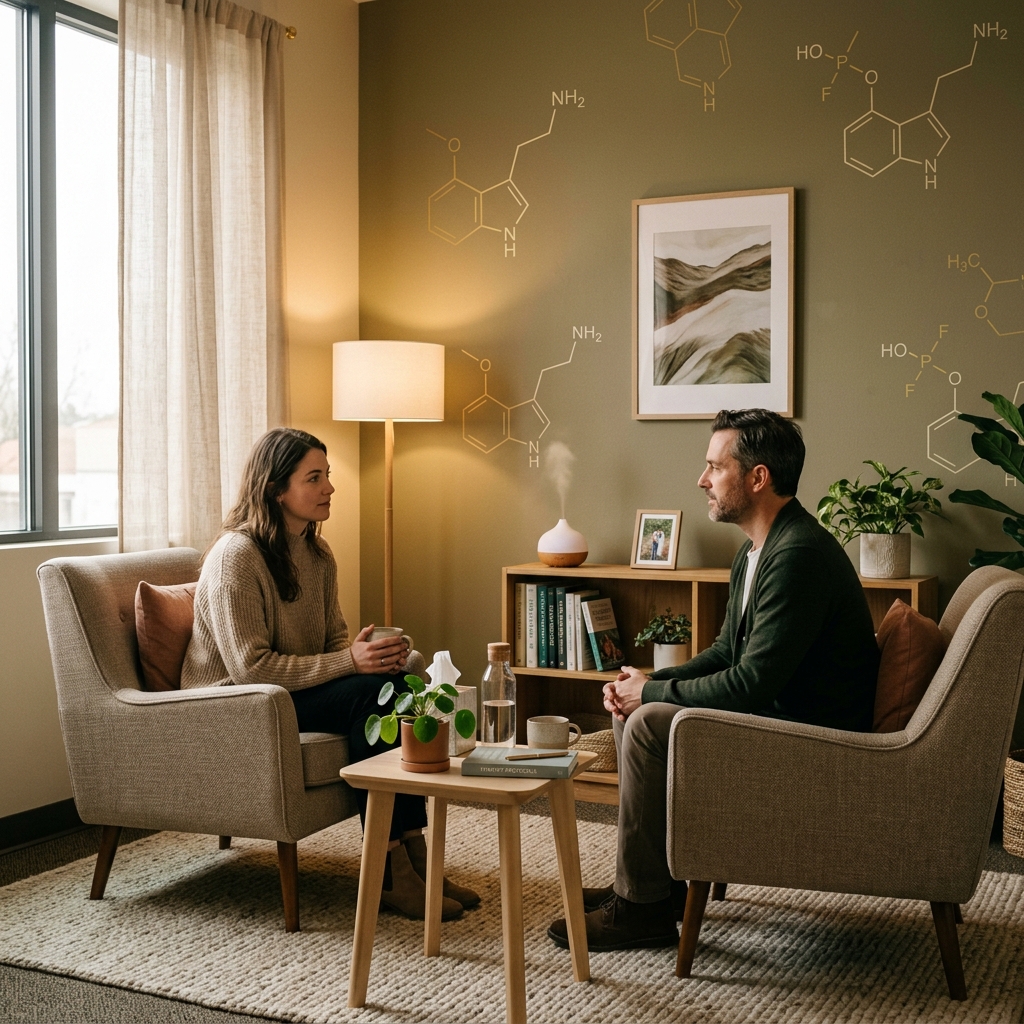
Clinical protocols pair psilocybin with intensive psychotherapy sessions during the days following administration — precisely when the plasticity window is open. The drug opens the door. The therapy walks through it.
What We Don't Know
- How long does the window stay open? Mouse data suggests ~2 weeks. Human data is preliminary.
- Is repeated dosing safe for plasticity? Too much plasticity could destabilize beneficial circuits. Optimal dosing intervals are unknown.
- Does the window open equally in all brain regions? Early data suggests prefrontal regions are more affected than subcortical structures, but this needs confirmation.
- Can we get the plasticity without the psychedelic experience? Several companies are developing non-hallucinogenic 5-HT2A agonists. Whether they produce the same plasticity effects is an active research question.
The most rigid part of being an adult may not be permanent. The brain's developmental windows might not be closed — just waiting for the right key.
Watch: How Psychedelics Rewire the Brain
A neuroscience overview of how psilocybin opens critical periods of neural plasticity in adults — the same windows of rapid learning that normally close after childhood — and what this means for treating depression, PTSD, and addiction.