The Experiment That Changed Everything
In 1983, a sleep researcher at the University of Chicago named Allan Rechtschaffen did something that would be considered unethical today. He kept rats awake — continuously, indefinitely — to see what would happen.
Within 11 to 32 days, every single rat died.
Their fur fell out. Their metabolism spiked uncontrollably. Their immune systems collapsed. Their body temperature regulation failed. They died not from any single organ failure, but from a total systemic breakdown — as if sleep deprivation had pulled a load-bearing column from the architecture of biological life.
No one has replicated this study in humans, for obvious reasons. But the implication has shaped sleep science for four decades: sleep is not optional. It is not passive. And it is not simply "rest." It is, as Matthew Walker later put it, "the single most effective thing you can do to reset your brain and body health each day."
Your Brain Has a Night Shift
The most stunning discovery in sleep science this century didn't come from a sleep lab. It came from a neuroscientist studying cerebrospinal fluid.
In 2012, Maiken Nedergaard and her team at the University of Rochester discovered something that had been hiding in plain sight: the brain has its own waste-removal system, and it's almost exclusively active during sleep. They called it the glymphatic system — a play on "glia" (the brain's support cells) and "lymphatic" (the body's waste network).
Here's how it works. During deep sleep, your brain's glial cells shrink by about 60%, opening up channels between neurons. Cerebrospinal fluid then rushes through these expanded gaps like a pressure washer, flushing out metabolic waste — including beta-amyloid, the protein that accumulates in Alzheimer's disease, and tau, another hallmark of neurodegeneration.
During waking hours, this system runs at about 5% of its nighttime capacity. You are, in a very literal sense, marinating in your own neural waste products for as long as you're awake. Sleep is when the cleaning crew arrives.
The implications are hard to overstate. A 2023 meta-analysis in JAMA Neurology found that people who consistently slept fewer than six hours per night had significantly higher rates of beta-amyloid accumulation. The relationship was dose-dependent: less sleep, more protein buildup, higher dementia risk. Sleep is not just restorative — it may be neuroprotective in a way that no supplement, nootropic, or meditation practice can replicate.
The Architecture of a Night
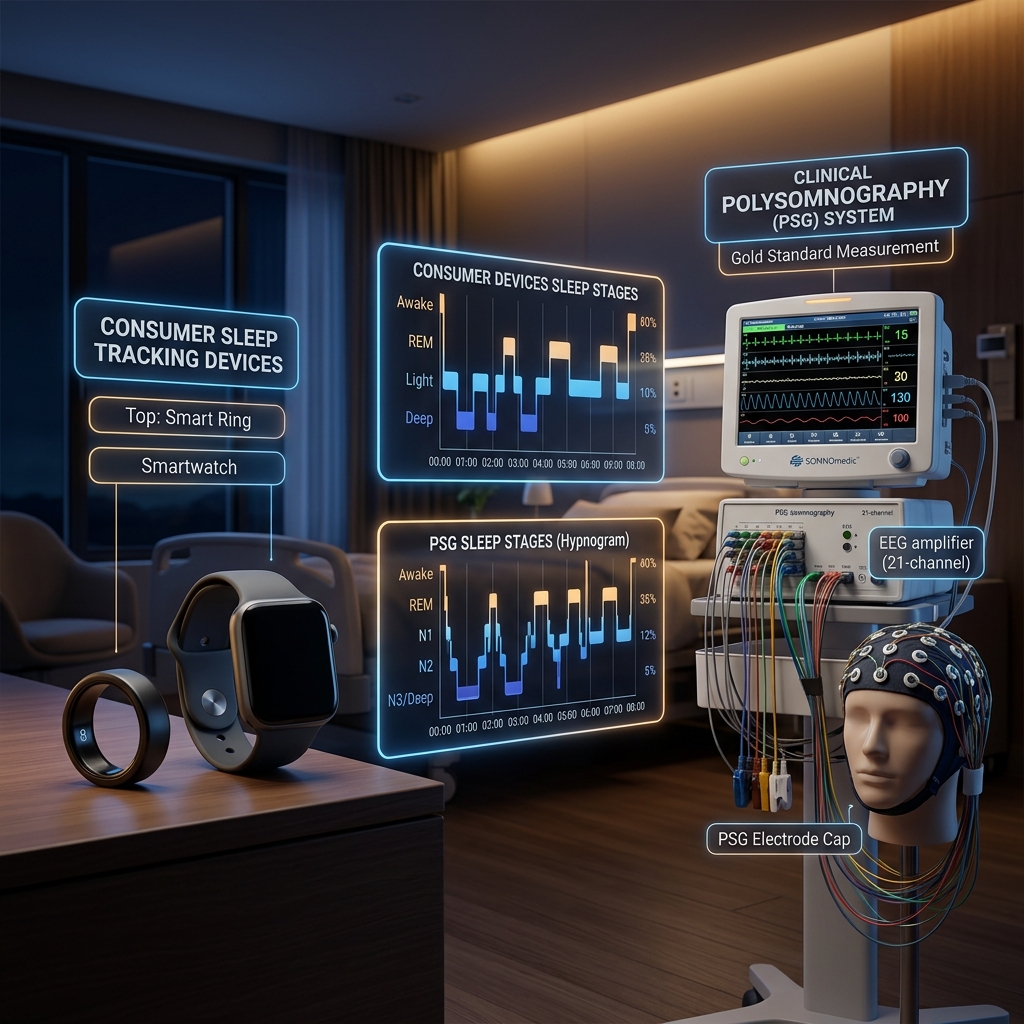
Your brain doesn't simply "turn off" when you sleep. It cycles through four distinct stages, each with a different neurological function, approximately every 90 minutes:
Stage 1 — The Transition (1-5 minutes). You're on the edge. Muscle tone drops. Heart rate slows. You can be woken by a whisper. This is the shallow end of the pool.
Stage 2 — The Filing Cabinet (10-25 minutes). Your brain produces rapid bursts of electrical activity called sleep spindles — short, synchronized oscillations that help transfer information from short-term to long-term memory. This stage accounts for roughly half your total sleep time. It's where your brain decides what to keep and what to discard from the day.
Stage 3 — The Deep Clean (20-40 minutes). Also called slow-wave sleep or N3. This is when the glymphatic system opens up. Growth hormone surges — not for growing taller, but for tissue repair, muscle recovery, and immune function. Your blood pressure drops to its lowest point. Your cortisol bottoms out. Delta waves — the slowest, largest brain waves — roll across the cortex like ocean swells.
This stage is brutally difficult to wake from. It's also the stage that declines most steeply with age — by your 50s, you may have lost 60-70% of the deep sleep you had at 25. This is not a trivial decline.
REM Sleep — The Rehearsal (10-60 minutes). Your brain becomes nearly as active as when you're awake. Your eyes move rapidly. You dream — not in the fragmented, half-aware way of lighter stages, but in vivid, narrative, emotionally charged sequences. Your body is temporarily paralyzed (a mechanism called atonia) to prevent you from physically acting out your dreams.
REM is where emotional processing happens. Walker's research at UC Berkeley has shown that REM sleep functions as a kind of "overnight therapy" — you revisit emotionally charged memories, but stripped of their original adrenaline context. This is why a painful memory often feels less raw after a good night's sleep. The informational content is preserved; the emotional sting is reduced.
PTSD, notably, is associated with disrupted REM sleep. People with PTSD often don't get the emotional detoxification that REM provides, which may explain why traumatic memories retain their visceral charge.
The Nervous System Reboot
During deep sleep, something remarkable happens to your autonomic nervous system: the sympathetic branch — your fight-or-flight accelerator — finally quiets down, and the parasympathetic branch takes over completely.
This nightly parasympathetic dominance is not a luxury. It's a biological requirement. During this window:
Heart rate variability peaks. The beat-to-beat variation that reflects nervous system flexibility reaches its highest point during deep sleep. This is one reason HRV-tracking wearables like WHOOP and Oura emphasize nighttime readings — they're measuring your nervous system's recovery capacity.
Cortisol reaches its nadir. The stress hormone drops to near-zero around midnight, then begins its slow climb toward the morning waking peak. People who don't get enough deep sleep often show flattened cortisol curves — the hormone stays elevated at night and doesn't spike properly in the morning, a pattern associated with chronic fatigue and inflammation.
Inflammatory markers drop. IL-6, TNF-alpha, and C-reactive protein — the trilogy of inflammatory biomarkers — decrease during consolidated sleep. One night of poor sleep can elevate CRP levels by 25-40%.
Memory consolidation completes. The hippocampus replays the day's experiences and transfers them to the neocortex for long-term storage. This process requires deep sleep's slow waves to synchronize with Stage 2's sleep spindles — a precise temporal coordination that alcohol, THC, and benzodiazepines all disrupt.
What's Actually Keeping You Awake
The sleep industry — worth over $80 billion globally — would have you believe that insomnia is a product deficiency. You need a better mattress, a weighted blanket, a sleep supplement, a white noise machine, a mouth-taping ritual.
Some of these help. But the research consistently points to a smaller set of high-leverage interventions:
Light is the master switch. Your suprachiasmatic nucleus — a cluster of about 20,000 neurons in the hypothalamus — sets your circadian rhythm based primarily on light exposure. Morning sunlight (10-15 minutes, ideally within an hour of waking) anchors the rhythm. Evening screen light delays it. The impact of light timing on sleep onset is larger than any supplement studied to date.
Temperature drops trigger sleep. Your core body temperature needs to fall by about 1°C (2-3°F) to initiate sleep. A cool room (65-68°F / 18-20°C) facilitates this. A warm bath before bed, counterintuitively, helps — not because it heats you up, but because the rapid cooling afterward accelerates the temperature decline.
Consistency trumps duration. A 2020 study in Scientific Reports found that irregular sleep timing — even when total hours were adequate — was associated with worse cardiometabolic outcomes. Your circadian system is a clock. It works best when you keep it wound.
Caffeine has a longer half-life than you think. At 5-6 hours, a coffee at 2 PM means you still have half the caffeine in your system at 8 PM. A quarter of it is still circulating at 2 AM. You may fall asleep — but the depth and architecture of your sleep are compromised.
The Dose-Response Nobody Talks About
The relationship between sleep and health is not linear — it's exponential at the extremes.
Going from 7 hours to 6 hours of sleep doesn't reduce your performance by 14%. It reduces it by far more, because you're cutting disproportionately into deep sleep and REM — the stages that occur most in the last third of the night. The last two hours of an eight-hour night aren't bonus sleep. They contain the majority of your REM cycles and a significant portion of your final deep sleep block.
This is why "I'll function fine on six hours" is one of the most dangerous beliefs in modern health. You might function. You will not be fine. Your immune surveillance drops. Your emotional regulation degrades. Your ability to consolidate learning falls off a cliff. And you won't notice, because one of sleep deprivation's most insidious effects is that it impairs your ability to assess your own impairment.
Walker calls this "sleep debt" — and the interest rate is brutal.
The Bottom Line
Sleep is not a luxury. It is not negotiable. It is the single most powerful recovery tool your body has, and it costs nothing.
Every system that matters — immune, cognitive, emotional, metabolic, cardiovascular — depends on what happens between the hours you're not paying attention. The glymphatic system doesn't have a supplement alternative. REM emotional processing doesn't have a meditation substitute. Deep sleep's growth hormone release doesn't have a biohacking shortcut.
The most sophisticated thing you can do for your health might also be the simplest: go to bed.
Sources: Xie et al., "Sleep Drives Metabolite Clearance from the Adult Brain," Science, 2013. Walker, "Why We Sleep," 2017. Nedergaard, "The Glymphatic System," Journal of Clinical Investigation, 2023. Fultz et al., "Coupled electrophysiological, hemodynamic, and cerebrospinal fluid oscillations in human sleep," Science, 2019. Rechtschaffen et al., "Sleep Deprivation in the Rat," Sleep, 1989. Shokri-Kojori et al., "β-Amyloid accumulation in the human brain after one night of sleep deprivation," PNAS, 2018.
Watch: The Stages of Sleep and Why Each Matters
A neuroscience tour of sleep architecture — the four stages of NREM and REM, how each contributes differently to memory consolidation, emotional processing, and physical repair, and what happens when the cycle is disrupted.