Overview
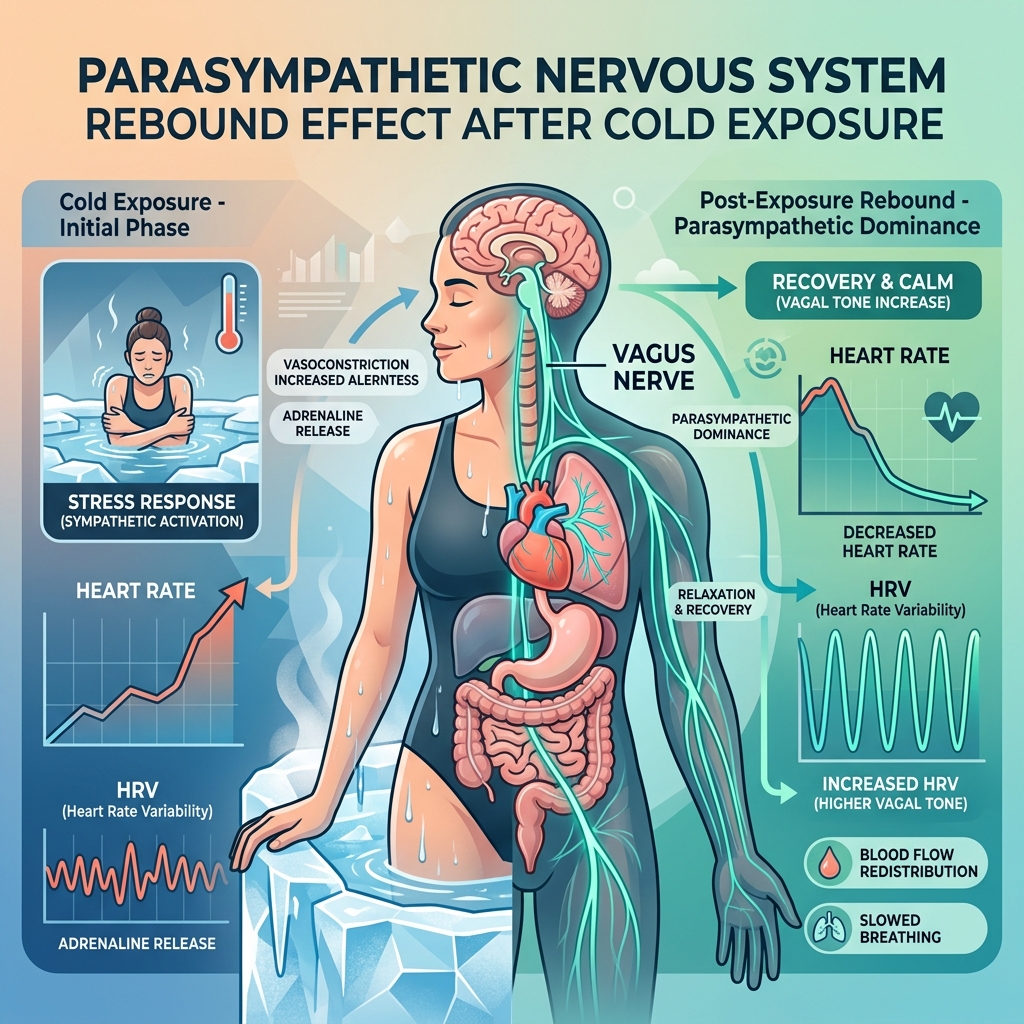
The subjective experience of cold exposure is paradoxical: the plunge itself feels like controlled panic — sharp inhalation, racing heart, urgent desire to exit — yet minutes later, practitioners report a state of calm alertness that can persist for hours. The autonomic nervous system's "parasympathetic rebound" explains this paradox and represents the primary mechanism through which cold exposure training builds nervous system resilience.
The Two-Phase Autonomic Response
Phase 1: Sympathetic Activation (During Immersion)
When skin temperature drops rapidly, cold thermoreceptors trigger an immediate sympathetic cascade:
- Heart rate increases 30-50% above resting baseline
- Blood pressure rises as peripheral vasoconstriction redirects blood to the core
- Catecholamines (norepinephrine, epinephrine) surge — norepinephrine can increase 200-300%
- HRV decreases as sympathetic dominance suppresses beat-to-beat variability
- Respiratory rate spikes with the cold shock gasp reflex
This is the stress response — evolutionarily designed to prepare the body for threat.
Phase 2: Parasympathetic Rebound (Post-Immersion)
Within 3-10 minutes of exiting cold water, the autonomic balance reverses dramatically:
- Heart rate drops below pre-immersion baseline
- RMSSD (the primary vagal tone marker) overshoots resting values by 15-40%
- High-frequency HRV power increases, reflecting enhanced cardiac vagal modulation
- Baroreflex sensitivity improves as the arterial pressure regulation system recalibrates
- Cortisol begins to decrease, while endorphin and endocannabinoid levels remain elevated
This overshoot — not merely a return to baseline, but a temporary enhancement of parasympathetic tone — is what produces the characteristic post-cold clarity.
Training the Rebound
Research from 2026 shows that the rebound effect becomes more pronounced and faster with repeated exposure. Experienced cold practitioners show:
- Faster RMSSD recovery (return to 80% of baseline within 5 minutes vs 12+ minutes for novices)
- Higher peak parasympathetic overshoot
- Shorter sympathetic activation during immersion
- Greater resilience to non-cold stressors (measured by HRV response to cognitive stress tasks)
Why This Matters for Body-Mind Practice
The parasympathetic rebound is not a side effect of cold exposure — it is the mechanism of action. Understanding this helps practitioners design protocols that optimize the rebound rather than merely enduring the cold. Key implications: longer is not always better (the rebound begins upon exit), temperature matters more than duration for triggering the response, and the quality of the recovery environment directly affects rebound magnitude. Practitioners should monitor RMSSD recovery as the primary outcome metric, not time spent in cold water.
Source
- Autonomic responses to cold water immersion and the parasympathetic rebound. — Frontiers in Physiology